Saturday, March 19, 2016

finally, an update.


I'm a few weeks back from my trip to the British Virgin Islands and I have lots to tell you.

First off, I promise this is the last time I'm away from this blog for so long. It's been hard with a small person needing and wanting all my time and energy and what seemed like this momentous eternity of treading water on this dream of ours. We had some hiccups. Our plan was to leave last fall. Obviously that didn't happen. It was a matter of waiting too late and simply not doing what needed to be done to Interlude that tripped us up. There were so many questions about how and if we were going to proceed with our potential cruising lifestyle this spring. Plenty of things hinged on one major piece of the puzzle. It wasn't whether we could financially make it work, it wasn't whether or not we were prepared to cut our ties with the creature comforts land life afforded us, it wasn't how we planned to raise a VERY busy toddler on a boat. Really, it was me. 

The decision of how to proceed depended on my seasickness. I haven't spoken about it much because it creeps up on me sometimes and not at other times. And when it has crept up on me, I've been down for the count. I start out sleepy, then nauseous and then eventually, occasionally, I vomit. Sorry for the visual, but if you've ever suffered with motion sickness, you feel my pain. It's not really ideal for someone who plans to live and thrive on a boat 24/7/365. Yeah. Imagine being sick all. of. the. time. Sounds miserable, right? The thing is that my sailing experience had been day sails on San Diego Bay (where I NEVER got seasickness), and on Lake Michigan. Any of you who have sailed on Lake Michigan know that she can be a blessing and a bitch. They don't call it the windy city for nothing. What comes with the sometimes spectacular wind is waves. Big, fat, tall waves. And they're super fun when they're coming on your beam. Note the sarcasm. Being tossed isn't fun, but it's a part of sailing.

Which brings me to my second of all....We are going sailing come June. Our cast off date is still based on the weather, of course. We have some projects to get taken care of and some preparing we need to do (more in my next posts about these projects). What lead us here is this: I went to the BVI for sailing school a few weeks ago as a live aboard and I wasn't sick the entire week. I started the few days before sailing school by hydrating myself properly and taking super doses of vitamin c (which I had read about here) starting right before we got on the boat. As long as I kept a snack nearby and kept my fluid intake up, I felt great. And that's how it went for a week. 

Honestly, with all that there was to be done, I don't know that I would have been sick anyway. I took a few American Sailing Association courses with a sailing school out of Nanny Cay in Tortola called Sistership Sailing School. If you are a woman or family looking to get comfortable on the water, I highly recommend looking into this. It was a great practical on the water training. Mostly it was familiar but I did get to experience some new things like: anchoring, mooring, and man-overboard drills. I got more comfortable with docking, jumping (hoisting) the main, and the rules "of the road" of sailing. There are areas I will continue to work on, but I feel confident and empowered by the week I spent sailing with Pat and the other 3 ladies on the crew with me. 

So, I'll be updating this blog more regularly and telling you all about preparations for our departure. We've got some awesome families who are going to help with a few projects that are upcoming and we couldn't be more grateful to them. Looking forward to sharing all that is to come with you guys.

And now, here are some photos from my adventures.


Sunday, September 27, 2015

an update.


Apologies for the radio silence. This season has slipped away from us and as a result, we will NOT be in the Caribbean come November. Interlude spent the winter in storage where she was supposed to have her chainplates replaced and unfortunately, that didn't happen until June. Our mistake was in not working on her all winter while she was indoors. We have several significant projects that still need to happen before we can cast off and we did not do them. Oops! Having a baby is time consuming, you know? This fall and winter, we will not make the same mistake. 

Projects we still need/want to complete:
  • Fix leaks over the butterfly hatch, v-berth and quarter berth
  • Replace some of the lights for LEDs. We did several this season, or rather Josh did, but there are a few more to go. This will help lower battery consumption in addition to the frequency of which the bulbs will need to be replaced.
  • Replace the head. This one is a biggie. We had plans to have my brother help do this while visiting but time got away from us.
  • Put lights and outlets in the cockpit. The lights will be LED but at this point we are trying to figure where to mount them. On the cabin top? On one of the bars of the dodger/bimini? To be determined.
  • Reconfigure storage situation in the lazarette
  • Possibly rebed the port lights
  • Convert the galley hand pump to a foot pump. Hopefully freshwater but we are toying with the idea of doing it as a seawater one.
  • Replace v-berth mattress
  • Account for all the engine spare parts
  • Repair a few tiny areas on the canvas on the dodger/bimini
  • Potentially replace the running rigging
  • Convert flat sheets into fitted ones for the quaterberth
  • Configure storage for long term cruising. This one is a toughie. I kind of need to wait until Josh has used all of his allotted storage to work on space for canned and dry goods and we need to take a good hard look at exactly how many clothes items and toiletries we realistically need. 
That's all I can think of now. I'll update as we go. Or hopefully, cross them off?

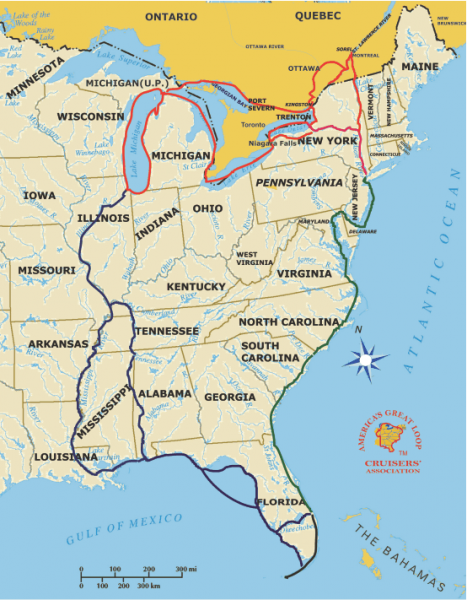
how do you get there?

http://www.greatloop.org/files/image/map%20with%20canada.png
Figure 1 The Great Loop (Image courtesy of http://www.greatloop.org )
When we tell people that we are planning on taking our boat from Lake Michigan to the Caribbean, one of the first questions is inevitably, “How are you going to get there?” To cruisers and people like us who having been dreaming about this voyage for over a decade, it seems like a silly question.  That, of course, is because I’ve spent countless hours reading and researching the best options and making pro/con lists of the various possibilities.  So for those of you who are interested, but don’t have the time or inclination to scour the web for the details, I’ll lay it out for you.  
There are three primary paths from Lake Michigan to the Atlantic Ocean.  (There are a few variations on these, but we will ignore that for the time being.)  They are 1.) the Great Lakes to the NY State Canal System 2.) the Great Lakes to the St. Lawrence Seaway 3.) the river systems.
I’ll start at the end of that list to explain why we haven’t seriously considered the river system.  From Lake Michigan, you can lock into the Calumet River or the Chicago Sanitary and Ship Canal, both of which meet up with the Des Plaines River, and then the Illinois River, which drops out into the Mississippi just north of St. Louis, MO.  Once on the Mighty Mississippi, you have the choice to follow it to New Orleans which can be pretty isolating for a river, as there is a stretch of 449 miles of the river that has NO docks or fueling opportunities (“fuel, you say? I thought you were on a sailboat?”, I’ll get to that in a minute). The other option is to hang a left at Cairo, IL and head up the Ohio River to the Cumberland River which will take you to the Tennessee River, to Yellow Creek, to the Tennessee-Tombigbee Waterway (the Tenn-Tom).  This route will eventually dump into Mobile Bay.  
At the start of this 1,300 mile route, step one is take down anything that is higher than 19.7 feet above the water.  For us that list is the mast.  That means that we would be running the engine for the entirety of that section, and that’s not really what we’re about.  With a maximum speed of 7.5 knots (nautical miles per hour) even at top speed, that would mean about 175 hours of driving though the rivers.  This route is very popular with “Loopers” as it going with the flow and makes it much easier than trying to fight the current.  “Loopers” are those adventurous souls who desire to cruise a loop around the eastern portion of the US.  They take the route described above south, then make their way from the Gulf of Mexico, around (or through) Florida, up the East Coast and back “in” through one of the next methods I’ll describe to go “out”. There is a great resource for those who are interested http://www.greatloop.org/index.php .  
The other two routes would start the same way for us.  A long sail up Lake Michigan to Mackinac Island (for the record, Mackinaw City is the on the tip of the Lower Peninsula of Michigan and Mackinac Island is just out from there, but one is the French spelling and one is the British spelling and they are both pronounced Mack-i-naw). From there, it’s down Lake Huron where the St. Clair River, Lake St. Clair, and the Detroit River lead to Lake Erie.  Cross Lake Erie where on the east end the final decision has to be made about the rest of the trip out.  From here it is either follow the St. Lawrence Seaway, via the Welland canals (because the Niagra river takes a bit of a rough dip) and Lake Ontario to the St. Lawrence River, or enter the NY State Canal System and roughly follow I-90 from Buffalo to Albany, where you enter the Hudson River and follow it down past Manhattan to the Atlantic.  
The St. Lawrence route is the route taken by commercial shipping traffic, which means that boats much larger than ours transit it on a regular basis.  This is both a pro and a con in that, there is room for us to leave our mast up and sail a good portion of it, but it also means that there will be large slow to maneuver vessels along the way, that we will have to stay out of the way of.  This route would take us up through Canada including Montreal and Quebec City and dump us into the Gulf of St. Lawrence, where weather permitting we could visit New Brunswick, PEI, Newfoundland and/or Nova Scotia.  Our timing being what it will as late in the season as we may be departing though, I imagine that most of these places will be frigid and most of the inhabitants shifted to winter survival mode rather than entertain visitors mode.  We would then have the entire East Coast of the US to explore.  
If we opted for the NY state canals, we would have to take our mast down for that trip as well, but it would be for about a week as we make the 340ish mile journey across the Empire State.  Another advantage of going East vs. South, is that it gives us plenty of options for the rest of the trip to the Caribbean.  We could head offshore from the Gulf of St. Lawrence or NY and head directly there (or make a stop in Bermuda). We could also follow the Intracoastal Waterway down along the coast so we could visit friends along the way.  We would still have the option, should weather permit, to take an “outside” run along the coast to get some salt air in the sails.  
At this point, my inclination is to take the St. Lawrence Seaway.  With the installation of AIS (more to come on that), we would have no trouble identifying, communicating with and avoiding commercial traffic.  It would not require the removal of the mast, and the associated costs hassles with that.  It would give us the opportunity to easily complete our first International leg into our friendly neighbor to the north.  The real down side would be if we are forced to wait too late into the season, it gets very cold along that route and depending on how El NiƱo turns out this year, we may not want to deal with the temperatures.  
The map included here is from http://www.greatloop.org/seasonal-great-loop-map-cms-1035 America’s Great Loop Cruiser’s Association also has some more great summaries of the various sections of the Loop http://www.greatloop.org/loop-segments-cms-1745 .  You may notice that there is a “shortcut” from Lake Huron to the east end of Lake Ontario.  That section includes the Trent Severn Canal across Canada.  That path is not a real option for us, as our design draft (depth of the boat below the waterline) is 6 feet and there are sections of that system that have an operational depth of 1.8 meters (5.9 feet), so we would be a bit too deep to safely transit it.  Not to mention the fact that we will likely have extra weight onboard with provisions and spares, so we may be a bit lower in the water than per the design.  We would also have to drop the mast to clear bridges along that route as well.  That does of course mean that we will not be eligible to take our boat for a train ride, at least not anywhere else in North America. Of course, if we end up in Scotland at some point, maybe we can take the boat for a Ferris wheel ride (just kidding, don’t think we’d fit through the rest of the canals).
The follow up to this question is always, “How long is that going to take?” and the answer to that one is more complicated.  We will be at the mercy of the weather and our interest in places we stop along the way, but pushing straight through, my estimates are that going south would take a minimum of three and a half weeks, the NY canals route, at least two and a half weeks, and St. Lawrence three and a half weeks.  The only real way to figure it out is for us to actually make the trip!  We will inevitably make some stops along whatever route we take, so in any case, I am planning on a month or two after we leave before we reach salt water.

Tuesday, May 19, 2015

surprise! we're back at it!


a sailor at only one week old!


can you even stand those gorgeous baby blues?


Annnnnd we now have a new crew member!! Meet our little guy, Fozel. No, we didn't actually name him Fozel, but in the interest in maintaining some privacy, that's what we'll be calling him on the blog. He's now almost 9 months (!!) and is an absolute joy. Who knew life could be so sweet?

As for us and Interlude, we are not back in the water yet, buuuuut Larsen is finally fixing the chainplate situation and we've done some bottom painting (more thorough post forthcoming) in the meantime. We've got plenty more in store for our lovely lady this season before we take off including: stripping more teak, replacing the head, adding a wind vane, and painting a new boot stripe/home port. Keep your eyes peeled for more posts. Can't wait to share the next steps of our big adventure.

Sunday, August 17, 2014

sunday share!

In the search for a versatile solution for entertainment onboard, there were many options for prepackaged 12 volt TVs, but none of them had great reviews.  I was inspired by some of the concepts Ben Ellison used for his “Chart Table 21” onboard M/V Gizmo (Panbo Chart Table 21). So I decided to try to find a television that I could run directly off of the boat’s 12 volt system without having to waste energy by using the inverter and then plugging in a power brick to convert back to DC.  I also referenced Bob Stewart over at Island Time PC (Island Time PC).  He has a nice list of monitors that can be run from 12 volt systems with a little bit of cord searching.  In a moment of serendipity, I received my weekly Costco email listing their sales.  One monitor stood out from the pack it was a Samsung T24C550ND.  It was on sale for $150 (Amazon has it for the same price), much cheaper than any other 12 volt 24” display I could find.  They actually sell it as a television as it has a built in tuner as well as a wonderful function called “ConnectShare” that allows you to plug in a USB drive to the back and watch videos, look at pictures, or listen to music directly from the drive.  Having converted a large portion of my collection to digital formats for consumption on an iPad, having the ability to watch movies off a flash drive seemed like a wonderful development. 

So step one was stopping by Costco on the way up to the boat.  We got the TV and tested everything out with the included power brick to ensure it would run fine and that the ConnectShare feature worked the way that it was billed ( it plays at least .mp4 and .avi videos pretty much flawlessly).  The next step was to try to figure out the best way to test out powering it from the 12 volt system.  I had emailed Bob Stewart to get his input on the matter and he sagely recommended ordering a compatible 12 volt plug online because who would want to cut up a perfectly good power supply.  Bob thought that it would likely have a 5.5 mm barrel plug, but when I started looking closer at the power plug, I discovered that the Model A4514 DDY 45W power supply had an OD of 6.5mm and an ID of about 4.3mm and that there was a central pin as well.  A few hours of quality time with Google and some obscure AV and gaming forums turned up that this type of connector was most likely what is referred to as an EIAJ-05.  And thanks to someone who goes by the online moniker of “Yeggster”, I was able to find the equivalent from several sources (Yeggster's comments) including one available locally at Radio Shack.  So a quick trip to Radio Shack and another $10.50, and I had a 5 Amp DC plug and cable (way oversized) (PN 270048)and a type T tip (PN 273322) that looked pretty close to what came with the TV.  The central pin, which I couldn’t reach with my calipers, looked a little bigger visually, but I thought it was worth a shot. Worst case scenario, I can always return the pieces locally if they don’t work. 

Fortunately for me, everything fit up nicely and the TV works just as before only this time it’s running on 12 volt power.  That will eliminate all of the losses associated with converting the power twice (DC to AC to DC) and help keep consumption to a minimum.  According to Samsung, the unit draws 23W typical, 0.3W on standby and a max of 45W. I’ll pull everything back apart and add a little dielectric grease to the connections and wrap the connection where the tip plugs into the cord with some rescue tape to finish it all up. 
Another advantage to this model monitor is that is that it as the standard VESA mounting holes on the back (75x75), so I can mount it on the bulkhead.  I plan on using a Cheetah Mounts APDAM3B Dual Articulating Arm mount that is rated to hold up to 115 lbs television even though this one only weighs a little over 9 lbs without the stand.  That’s a pretty significant safety margin that should be able to withstand pounding into some pretty heavy seas.

Future plans for the monitor include hooking it up as a second screen for the boat computer which will either be a 12 volt powered mini computer or a laptop as well as possibly a repeater screen for the nav system.  It will also be home to a Chromecast which we should be able to get up running once the next project, an onboard wi-fi network, is completed.


Image 1 You can see the completed plug as well as the mounting holes and the additional connections available on the unit


Image 2 The future home of the unit. Three-quarter of an inch wood screws will hold the mount solidly to the bulkhead


Wednesday, July 23, 2014

did you know


Stumbled across this posting on a tumblr site I follow and couldn't resist sharing with you. Being so young and now undertaking this journey with a baby, we certainly feel the dismay of those around us when we tell them our plan. But we feel it's important that each of us follow our own path. Maybe it's not for you. And that's fine. We don't begrudge you that. It is, however what we feel strongly about. Something we feel we need to do for our own satisfaction. Enjoy. This pretty much says it all.

"Did you know, you can quit your job, you can leave university? You aren’t legally required to have a degree, it’s a social pressure and expectation, not the law, and no one is holding a gun to your head. You can sell your house, you can give up your apartment, you can even sell your vehicle, and your things that are mostly unnecessary. You can see the world on a minimum wage salary, despite the persisting myth, you do not need a high paying job. You can leave your friends (if they’re true friends they’ll forgive you, and you’ll still be friends) and make new ones on the road. You can leave your family. You can depart from your hometown, your country, your culture, and everything you know. You can sacrifice. You can give up your $5.00 a cup morning coffee, you can give up air conditioning, frequent consumption of new products. You can give up eating out at restaurants and prepare affordable meals at home, and eat the leftovers too, instead of throwing them away. You can give up cable TV, Internet even. This list is endless. You can sacrifice climbing up in the hierarchy of careers. You can buck tradition and others’ expectations of you. You can triumph over your fears, by conquering your mind. You can take risks. And most of all, you can travel. You just don’t want it enough. You want a degree or a well-paying job or to stay in your comfort zone more. This is fine, if it’s what your heart desires most, but please don’t envy me and tell me you can’t travel. You’re not in a famine, in a desert, in a third world country, with five malnourished children to feed. You probably live in a first world country. You have a roof over your head, and food on your plate. You probably own luxuries like a cellphone and a computer. You can afford the $3.00 a night guest houses of India, the $0.10 fresh baked breakfasts of Morocco, because if you can afford to live in a first world country, you can certainly afford to travel in third world countries, you can probably even afford to travel in a first world country. So please say to me, “I want to travel, but other things are more important to me and I’m putting them first”, not, “I’m dying to travel, but I can’t”, because I have yet to have someone say they can’t, who truly can’t. You can, however, only live once, and for me, the enrichment of the soul that comes from seeing the world is worth more than a degree that could bring me in a bigger paycheck, or material wealth, or pleasing society. Of course, you must choose for yourself, follow your heart’s truest desires, but know that you can travel, you’re only making excuses for why you can’t. And if it makes any difference, I have never met anyone who has quit their job, left school, given up their life at home, to see the world, and regretted it. None. Only people who have grown old and regretted never traveling, who have regretted focusing too much on money and superficial success, who have realized too late that there is so much more to living than this."


This. Every single thing about this. It falls in line with our beliefs as travelers and wanderers. This is the life we want to give to our child. A life free from the trappings of things and the need to "fit in" with the norms of our American society. The most interesting people you'll ever meet are the ones who take that leap. Who trust in themselves and the wholeness and beauty of the world surrounding them. Who never, for one second doubt that there is more to living than what society tells us we should want for ourselves. Who experience the culture of others, who nurture a spirit of humanity and soak up every new opportunity given to them. That. That is what living is. We just can't wait to see the world and show it to our little one in this way.


sunday share!


This post is also known as "mistakes were made". This is a cautionary tale. Generally on the Sunday share I want to tell you about an awesome or helpful upgrade project we've done. This one? Yeah, great theory but mistakes were definitely made. 

Back story: I regularly clean the cabin sole (floor of the cabin) since we have a dog who sheds profusely. And I am not kidding when I say PROFUSELY. When I clean the floor, I start by vacuuming (we have a long runner rug and a few doormat rugs) then follow with hand-wiping with Simple Green and a rag then sometimes taking a pass at it with another rag and some Old English Lemon Oil. This makes the floor shine but also causes a certain slippery-ness. I also include the companionway stairs when I do this routine, so you can imagine that with bare feet or low-tread shoes, coming down those steps can be a little dangerous. Actually, even between cleanings when you come down them with damp feet they can be treacherous. In addition to having no texture besides varnished and sealed wood texture, they are also very steep. 

And then I had a brilliant idea. Treads! I've seen them on countless production boats so I assumed they'd fix our problem. They did, but we made a few errors in the process. Josh was able purchase a 6 pack of adhesive treads for just such a use. I cleaned the steps and set about applying them (peeling the backing and centering them on the steps. Josh thought maybe we should wrap them around the forward edge of each of the steps (see photo) because he was sure we stepped up them we used the surface closest to the edge more than the middle depth of each stair. Okay, so I did that. Everything seemed fine until we decided to actually come down them. Did I mention that these stairs are notoriously steep? And that the overhang from one down to the next is pretty narrow? It is. And this means that when you walk down them in shorts, you catch the back of your leg on the sandpaper-like surface and scrape your leg. Not only scrape it, we are talking break the skin abrasion. Like it leaves a mark and you bleed down the back of your calf. Or your thigh if you lean up against them when you're trying to reach a particularly unreachable cabinet space. Ta-da! So lesson is this. DO NOT WRAP THE TREAD AROUND THE FRONT SURFACE OF EACH STEP. If we hadn't done that, these treads would have been a no-brainer home run. As they are, we'll keep them and develop tough calf skin until they need replacing and never make the same mistake again.